Pricing and new-product validation
Validating a new product line before committing to the roadmap
9 of 12 ICPs tested said they would hire the product (7 of 9 customers and 2 of 3 non-customers). 10 of 12 accepted the Plus plan at ~+25% over the existing plan. Three months from open question to a phased roadmap and pricing decision.
The situation
Candis sells invoice-management software to German SMBs. By 2024, Sales was losing larger deals to one recurring objection: no travel & expense (T&E) management. Prospects wanted one place for all company spend, and many competitors already offered it.
The question for Management was “should we build T&E, iterate, or abandon the idea?” And if ‘build’, what to build first, how to position it, and what to charge, with enough confidence to commit engineering capacity in the 2025 plan. I led the research, working with a Product Manager, a Product Marketing Manager and a Designer.
What I decided
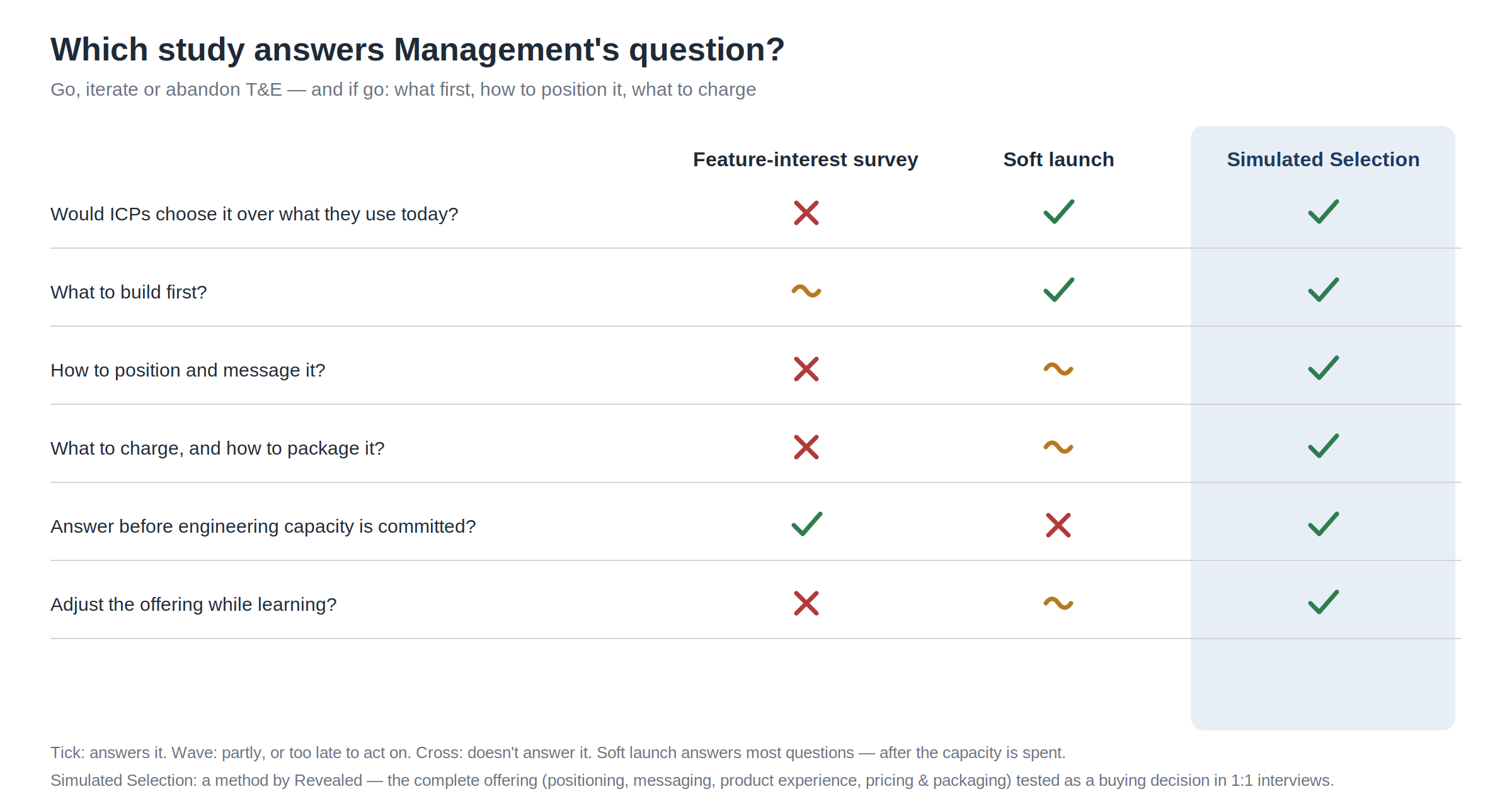
Test a buying decision, not feature interest. The quick routes would have been a customer survey on feature interest, or shipping a minimal version and watching adoption. Neither answers the question Management was actually asking: whether ICPs would choose a T&E offering from Candis over what they use today, and a wrong answer would have committed engineering capacity to the wrong thing. I used Simulated Selection, a method I helped develop during my time at Revealed and one I had applied in my consulting work there: assemble the complete offering (positioning, messaging, product experience and pricing & packaging) as a Figma prototype, then observe in 1:1 interviews whether target customers would choose it, scoring Willingness to Hire across relevance, desirable job, trust, usability, adoption cost and value for money. The method is built for speed and for exactly this decision: continue iterating, build and go to market, or stop.
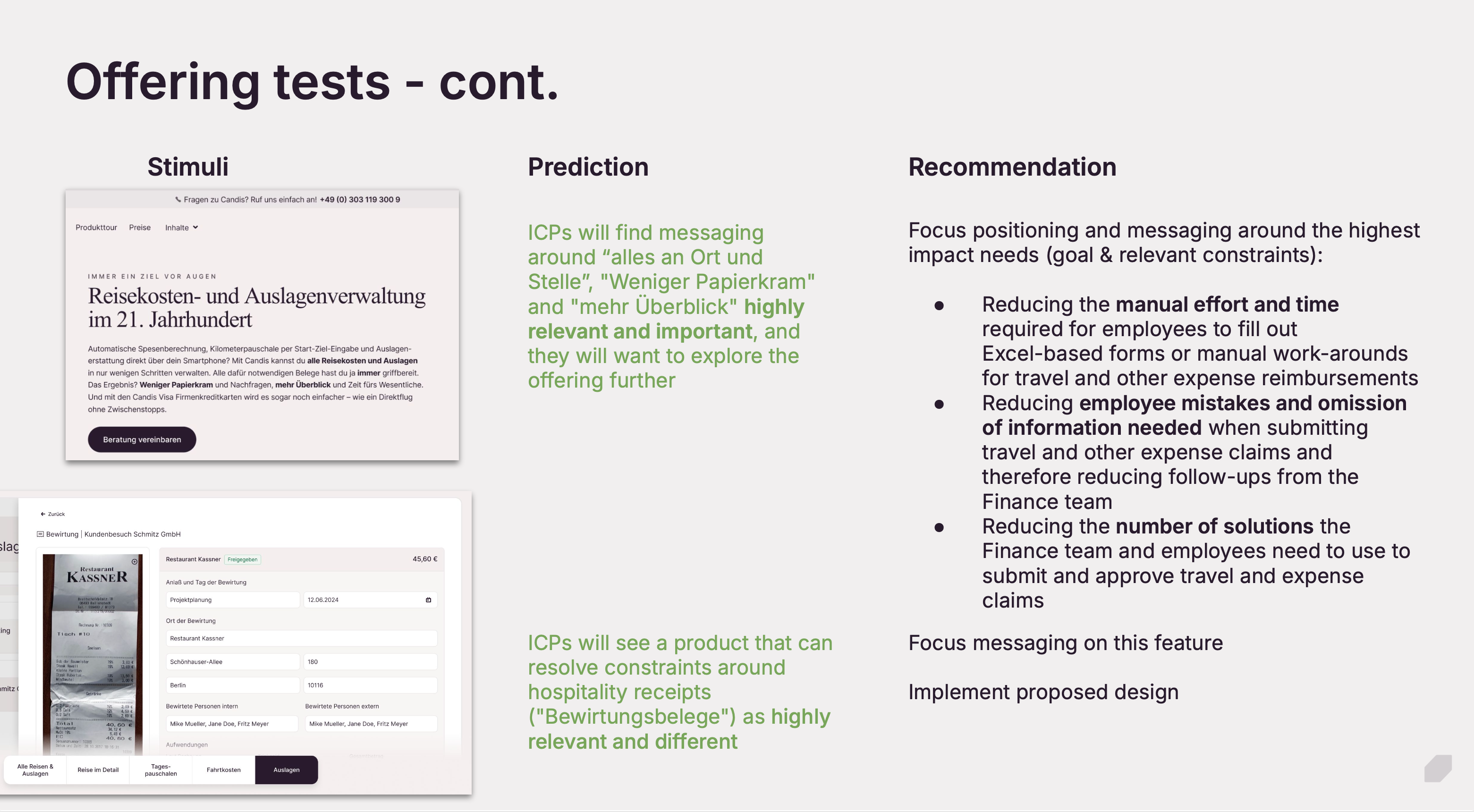
Debug the offering between interviews. Simulated Selection treats every session as a test of the whole offering, so when a message or a pricing tier failed we changed it before the next round rather than waiting for a final report. After the first round the messaging wasn't doing its job: participants were not engaging with the pitch. We rewrote it around three phrases that had come up unprompted and clearly mattered to ICPs: alles an Ort und Stelle (everything in one place), weniger Papierkram (less paperwork) and mehr Überblick (a clearer overview). In the rounds that followed, participants wanted to explore the offering rather than stall at the pitch.
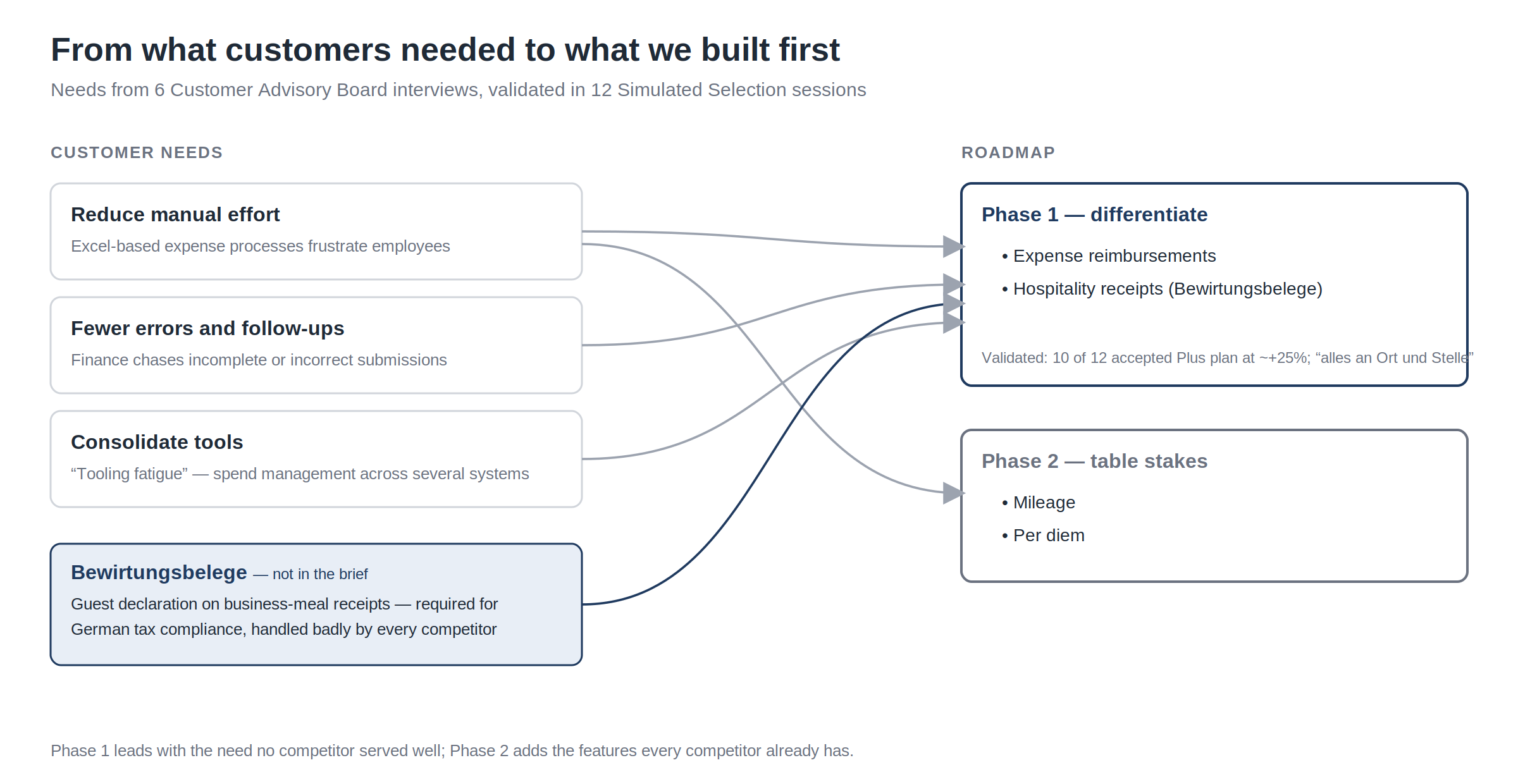
Follow the surprise. The brief assumed table-stakes features: reimbursements, mileage, per diem. In the six Customer Advisory Board interviews something else surfaced as very important to Finance teams: Bewirtungsbelege, the guest declaration required on business-meal receipts for German tax compliance. Competitors handled it poorly; Finance teams hated chasing it. I put hospitality receipts at the centre of the offering test, and it became the differentiation story rather than a footnote.
Where it was harder than planned. Non-customers were the hard part. Customers came from the Advisory Board and the CRM in days. For non-customers we had the Candis Research Panel I'd built with our BI analyst earlier, but a panel isn't a queue: I didn't want to keep recruiting the same people, and many of the rest were unavailable or didn't respond in the window we had. External panel providers couldn't fill the gap in time either; finance decision-makers at German SMBs are a niche audience. With the 2025 planning deadline fixed, I ran with the three ICP non-customers we could get, used them as a check that demand wasn't a loyalty effect rather than as a sample in their own right, and said so in the recommendation. For later studies I started non-customer recruitment before the study did, not during it.
Time, depth, team
Three months, end to end: competitive landscape of the German T&E market (features, positioning, pricing, customer sentiment), six CAB interviews on current T&E processes, twelve Simulated Selection sessions with nine customers and three non-customers who fit the ICP. My role: research design, prototype content, interviewing, analysis and the recommendation; the PM, PMM and Designer co-owned the prototype and the roadmap translation.
What the organisation did with it
- Go decision with executive buy-in. 9 of 12 participants showed Willingness to Hire (7 of 9 customers and 2 of 3 non-customers who fit the ICP). The non-customers were too few to be a sample, but enough to check that the demand wasn't only loyalty. CAB members independently showed strong demand for T&E within the Candis product. 10 of 12 accepted the Plus plan at roughly +25% over the existing plan; the two who declined were long-standing customers on discounted or legacy contracts.
- Roadmap phasing. Phase 1: expense reimbursements with hospitality receipts (the differentiator). Phase 2: mileage and per diem (table stakes). The proposed feature set was validated as sufficient for market entry.
- Positioning and pricing. “Alles an Ort und Stelle” (everything in one place) resonated strongest; the ‘Plus’-plan upgrade model was validated, with constraints identified for legacy customers.
- Sales enablement. Segment profiles (high-frequency travellers, Excel-dependent finance teams, multi-tool consolidators) and competitive positioning went to Sales for prospecting and pricing conversations.
What I’d do differently: We tested 1 price point. 10 of 12 participants accepted the Plus plan at roughly +25% over the existing plan, which told us the price was viable but not how much headroom there was above it, or where resistance would have started below it. The two who declined were long-standing customers on heavily discounted or legacy Basic contracts, for whom the jump was three to four times what they paid today; that's a migration problem, not a value problem, and the study wasn't designed to separate the two. Next time I'd test two or three price points across the sessions and report acceptance at each with the sample size beside it, so the number that travels through the organisation is "10 of 12 at +25%, n=12" rather than "validated up to +25%".
← All case studies Next: Research operations →