Sales coaching
Coaching sales and client success teams to work through prospect indecision
2 teams and 11 reps were coached on what stalled physicians most: indecision, not objections. Each team had 6 fortnightly sessions before the busy season, then more than 30 team and personal reports, each ending on one action per rep. In July, management widened the scope to policy increases, and the managers signed off a daily coaching digest.
The situation
The client is a broker that sells disability and life insurance to physicians, most of them still in training. Its busy season, May to August, decides the year, and its 2026 target was more closed cases from the meetings it already booked. Physicians arrived intending to buy and then stalled, on the sales call, at the application and again at signing. Management's question was what the Sales and Client Success teams could do differently on their calls before the season started. Together with my business partner, I led the analysis, the coaching sessions and the reporting.
What I decided
Make indecision the target, not objections. The usual starting point would have been objection handling, but that answers a physician arguing against cover, and these physicians weren't arguing. They wanted the cover and couldn't commit: the most common hesitation was fear of getting it wrong, a denial, an exclusion, or locking into the wrong policy, and "I need to talk to my spouse" was usually a polite way to postpone. I had used the JOLT framework (Dixon and McKenna's research on customer indecision) with the Sales team at Candis, and it fits this problem: judge the indecision, offer a recommendation, limit exploration, take risk off. So we built the reporting around it. The first two reports, in February 2026, covered 119 calls and scored each moment of hesitation by type and by how the rep responded.
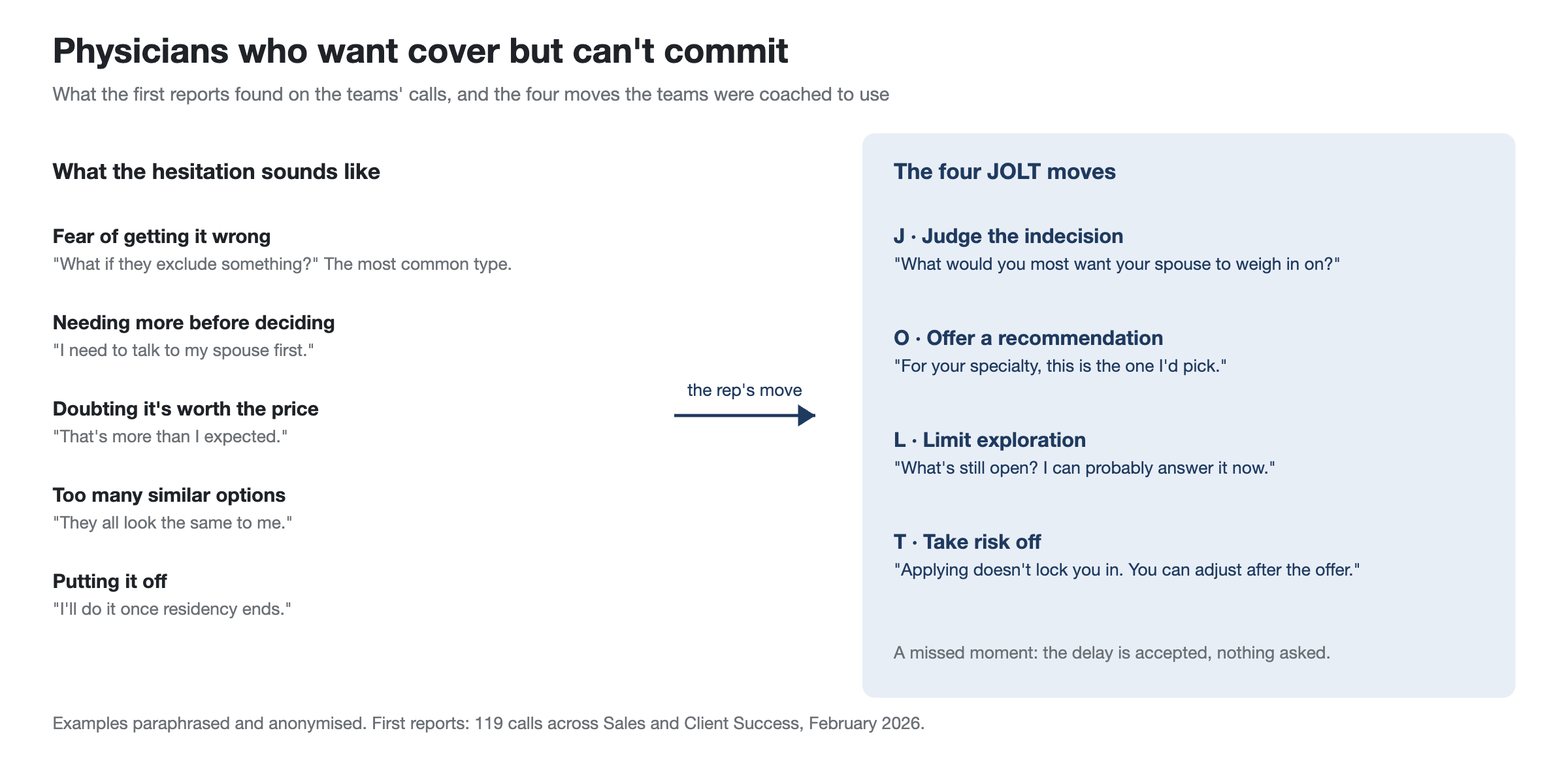
Coach fortnightly before the season, with the teams' own calls. A one-off workshop would have been quicker, but it teaches the four moves once and leaves the teams to apply them from memory. Every two weeks each team saw fresh moments from its own calls instead: a call where a rep made a physician's decision feel small and reversible, next to one where a delay was accepted without asking what was behind it. The aim was to change how the teams thought about hesitation, not only how often they used a technique. That showed in their own words: the reps started saying that "applying isn't buying" and making a strong insurance carrier recommendation, and Client Success described its role as "selling our service" as opposed to handling cases.
Give each manager one action per rep. Managers told us the most useful thing we could give them was real calls they could coach from. A per-rep report can easily list every gap. Instead, each personal report opens on something the rep already does well, shows two moments from their own calls where the same skill was used and two where it wasn't, and ends on one action for the manager's 1:1, for example "ask one diagnostic question before any logistics". Team reports went to the managers; personal reports only reached a rep through their manager.
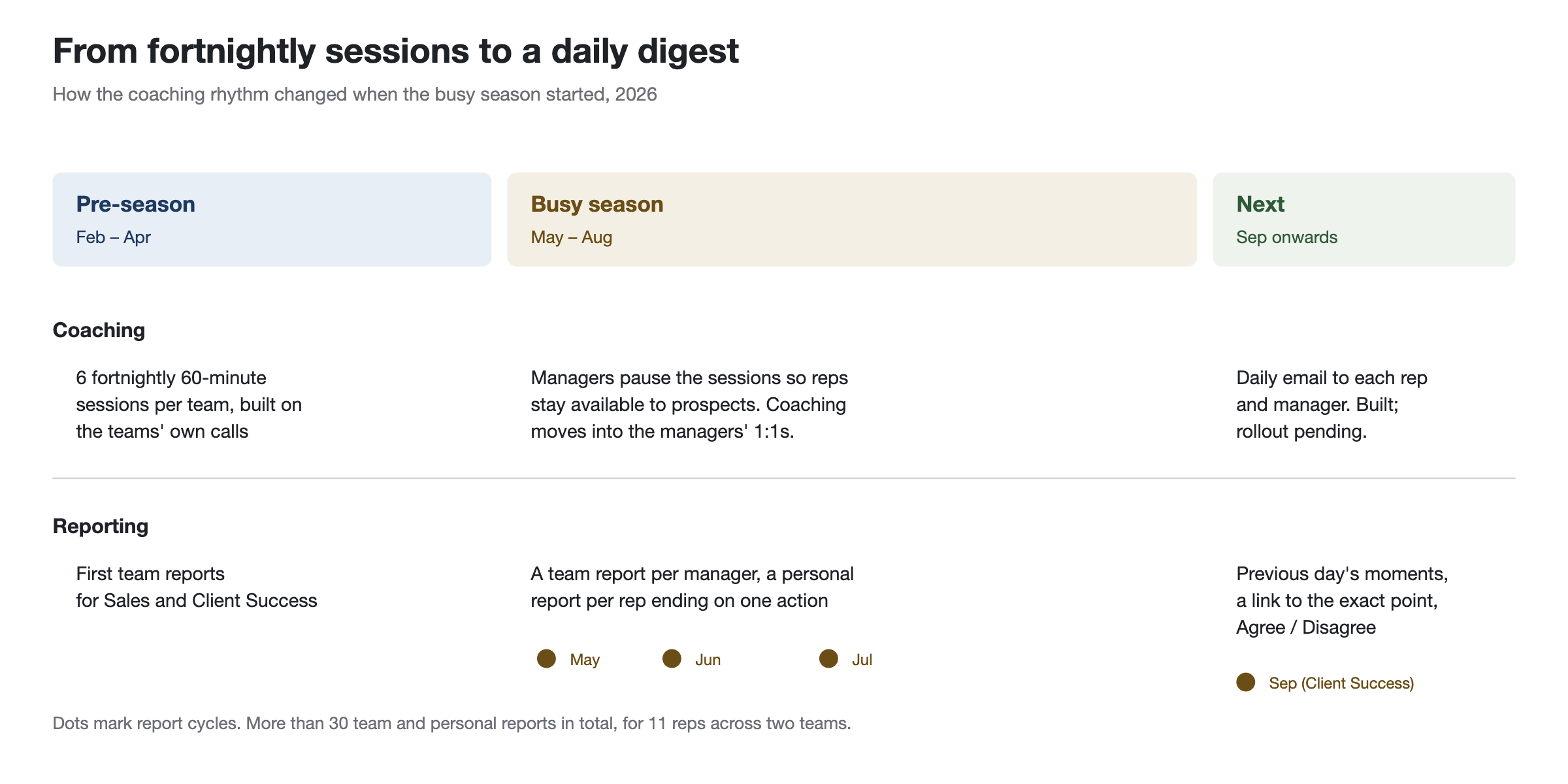
Where it was harder than planned. The fortnightly sessions were designed for the run-up to the busy season. Once it started in May, both managers asked to pause them so the teams could stay available to prospects as much as possible. We moved to written reports at each quarter end, plus refreshes when the managers asked: a team report for each manager, and a personal report for each rep with examples from their own calls. Coaching moved into the managers' existing 1:1s.
Time, depth, team
February to September 2026. Two teams, 11 reps, 6 sessions per team (Feb to April), four report cycles and more than 30 published reports. Me: analysis, session design and delivery, and every report. Business Partner: analysis pipeline development and co-facilitation of coaching sessions.
What the organisation did with it
- Reps changed how they communicate. In a live exercise, Client Success rewrote its messages to physicians to be shorter and more direct, and both teams now describe hesitation in the JOLT terms they were coached on.
- Managers kept asking for more. The Client Success manager asked for two refreshes during the season, and management widened the scope to policy increases in July.
- Daily coaching digest built. The managers signed it off in July. Rollout is pending.
- Handover between teams is on the agenda. Both teams now treat indecision as something that resurfaces when a physician moves from Sales to Client Success, not a one-off. The digest build also flags indecision on the CRM record, so the next person sees what they're up against.
What I'd do differently. We started coaching as soon as we started measuring, so there was no baseline for the same reps in a season without coaching. The reports show the teams using the framework and describing indecision in their own words; they can't show how much revenue that moved, and this page doesn't claim it. The reps who improved most were also the ones who started lowest, and some of that gain would have come anyway because they had the most room to move. Next time I'd score a full season before the first session, and judge each rep's progress against their own starting point rather than against the team.
← All case studies Next: AI-assisted conversation analysis →