Win-loss research
What makes physicians buy, and where an insurance broker's sales process let them go
14 win-loss interviews, each checked against the broker's CRM, calls, texts and emails. 9 of 14 started shopping because of a training transition. In 5 of 7 lost accounts, the broker's Sales and Client Success teams still had a move they could have made. Four weeks from shortlist to leadership, and the COO commissioned a win-loss analysis every quarter.
The situation
The client is a broker that sells disability and life insurance to physicians, most of them still in training. Its "busy season", May to August, decides the year. The CRM showed leadership where deals stalled, but not why physicians said yes or no, or what they were comparing the broker against. I led the study end-to-end.
What I decided
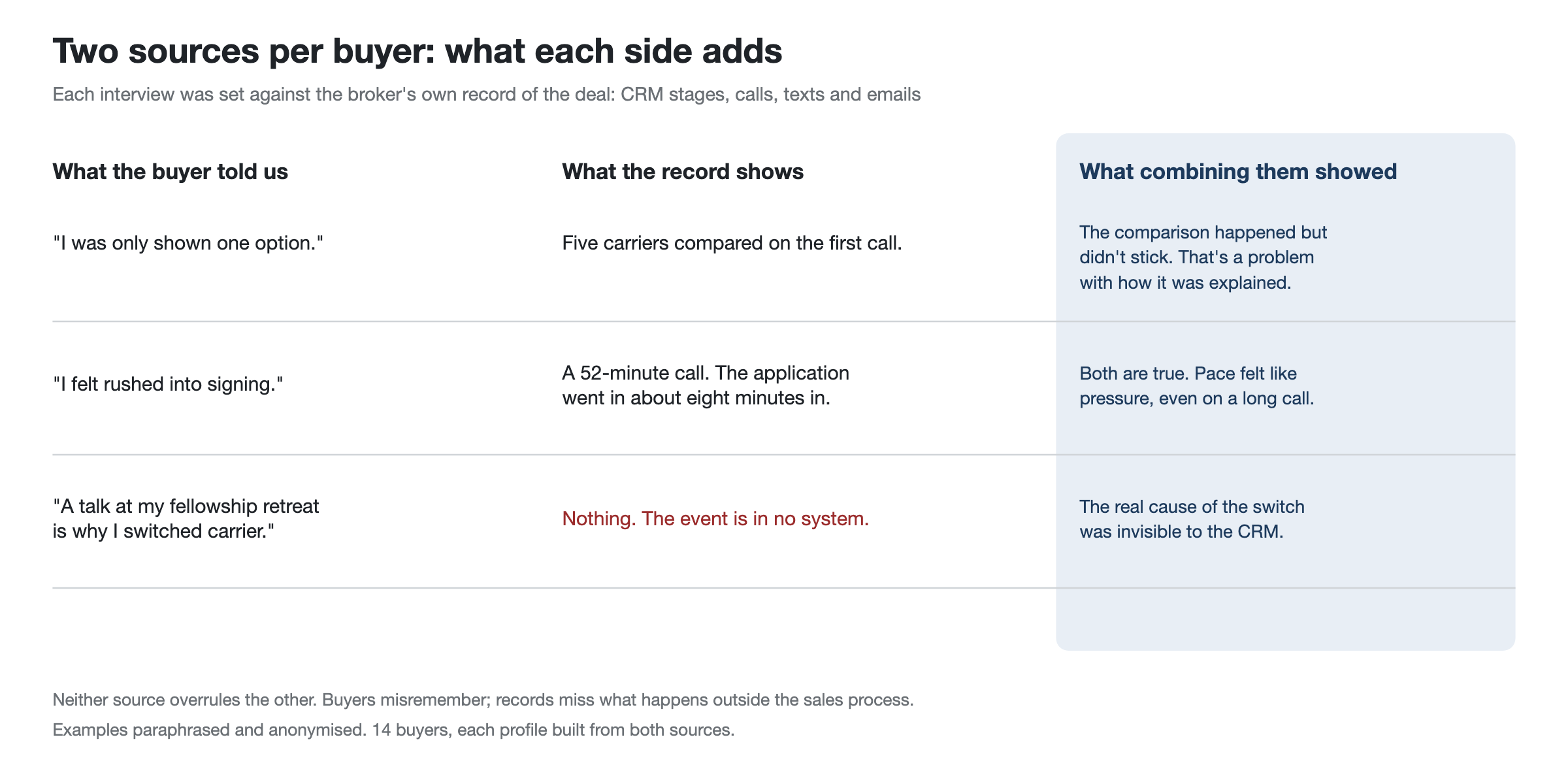
Combine the interviews with the record. Ponder holds the client's CRM and full customer communication history (calls, voicemails, emails and SMS messages) in its own database, so I rebuilt all 14 cases from the record and set each one beside the interview I conducted. The interviews produced findings of their own; the record added more, and confirmed or contradicted what buyers told us. One physician remembered being offered a single option, but the record shows five carriers were compared on the first call. Neither source could overrule the other: buyers misremember, and records miss what happens outside the sales process. Every insight rests on both sides: the buyer's experience and what the broker's systems recorded.
Stress-test the draft before it shipped. The risk with a report for revenue leaders isn't being obviously wrong. It's being confidently wrong in a way a sceptical operator in the room spots and uses to dismiss the whole thing. My partner's review and mine tended to confirm the framing we had already chosen. So I ran an adversarial review of the internal draft against the transcripts and analysis files: a reviewer set up to make the recommendations fail. Two of the three examples behind the headline recommendation failed. One buyer had already raised the issue and got a good answer; another's alternative only appeared months after the deal closed. A "4 of 8 losses" claim had the wrong denominator, because there were seven losses. And the draft had avoided an uncomfortable category: cases where the broker had the information and didn't act on it. A full check of every profile against both sources followed before leadership saw anything.
Follow the surprise. The brief asked why deals were lost. Buyers kept answering why they were shopping now: 9 of 14 named a training transition, such as finishing residency or fellowship, starting as an attending, or the last chance at rates for trainees. The CRM records the channel but not the trigger, yet it already holds those transition dates. I recommended timing outreach to training milestones rather than age or state. The COO tied it straight to an existing outreach campaign.
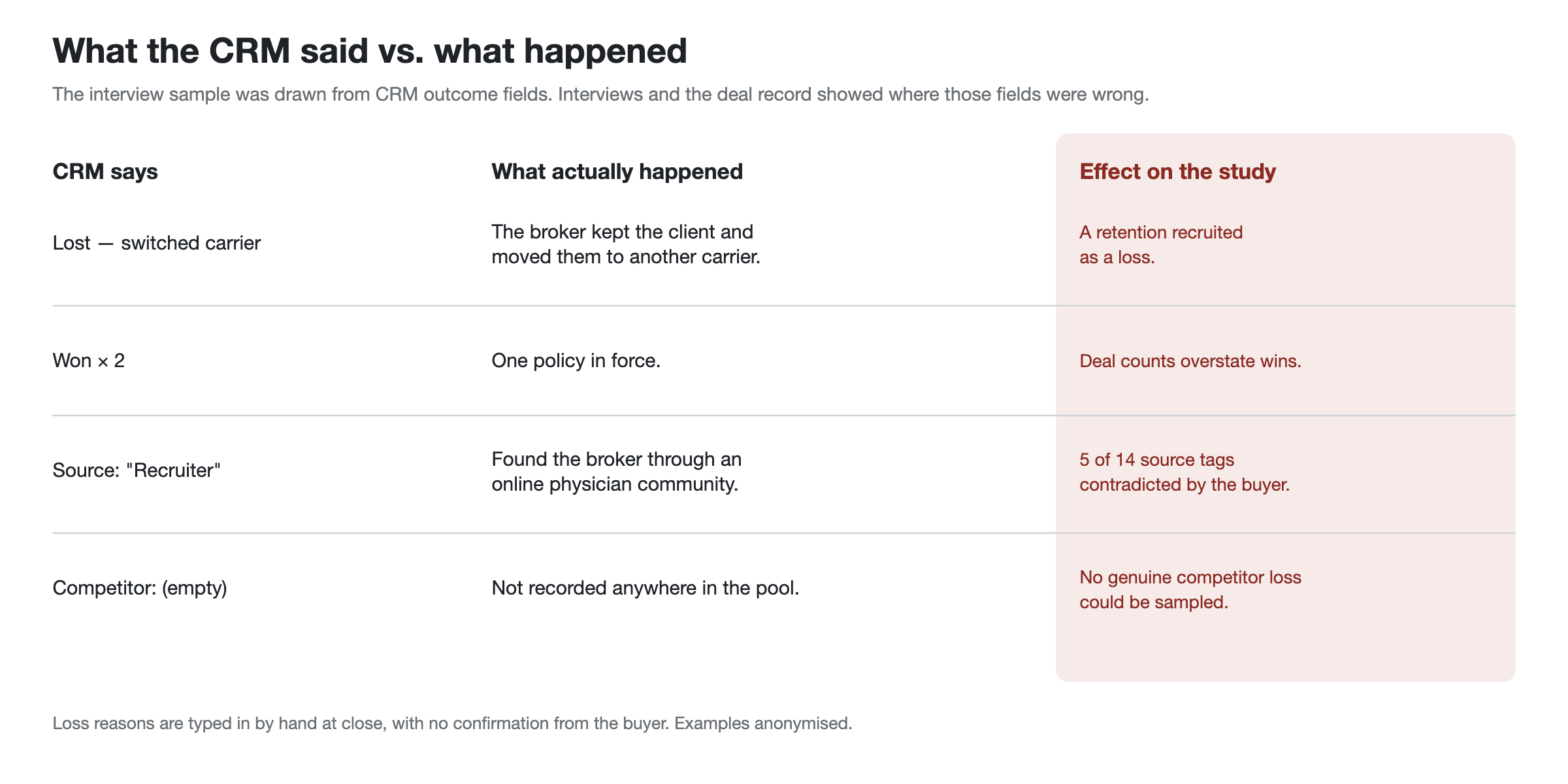
Where it was harder than planned. The sample came from CRM outcome fields, and they weren't reliable. Several "lost — switched carrier" deals were really clients the broker kept and moved to another carrier. No competitor was recorded anywhere in the pool, so a genuine competitor loss couldn't be sampled. Loss reasons are typed in by hand at close. I checked every candidate's other deals before inviting them, reported outcomes by account rather than by deal, named the missing competitor-loss case as a gap, and sent field fixes to the client's BI analyst. Since then, I check outcome labels against the record before recruiting.
Time, depth, team
Four weeks. A recruitment list of 356, 14 recorded 30-minute interviews over eight days, and 14 case reconstructions. Me: design, recruitment, interviews, analysis, and the presentation to leadership. Business Partner: analysis and presentation review.
What the organisation did with it
- Quarterly programme commissioned. The COO wants the study repeated each quarter with a trained interviewer because Sales and Client Success reps cannot go into the depth a Researcher can.
- Leads that didn't convert are no longer written off. The Sales lead committed to following them up.
- Outreach timed to training milestones, linked to the existing campaign and using dates the CRM already holds.
- Wins turned into marketing. Leadership asked for the anonymised quotes from wins, which consistently describe how little effort buying took.
- CRM fixes. New loss-reason and source options, plus corrections to records the study showed were wrong, went to the client's BI analyst and were implemented.
What I'd do differently. Some counts changed during the final checks. "4 of 5 physicians weren't told they could apply to a second carrier" became 2 of 5 once I re-read each case: two had been told on the first call, and one couldn't remember either way. The cause was that I decided what counted as "not told" case by case as I went through the interviews, instead of writing that rule down first. Fourteen hand-picked interviews show that something happens, not how often: "9 of 14" means a training transition is a common enough trigger to design outreach around, not that 64% of all buyers behave that way. Next time I'd define what counts before the analysis, and report each number against the cases it could be checked on.
← All case studies Next: Churn research →